Decking spacers and support pads are small components used at different points in a deck. A spacer between a board and a joist creates separation at the fixing point. A rubber pad beneath the frame separates it from a hard base and helps cushion vibration.
They are often grouped together, but their functions are different. Choosing the right component starts with knowing which contact point you need to improve.
Why use spacers and pads?
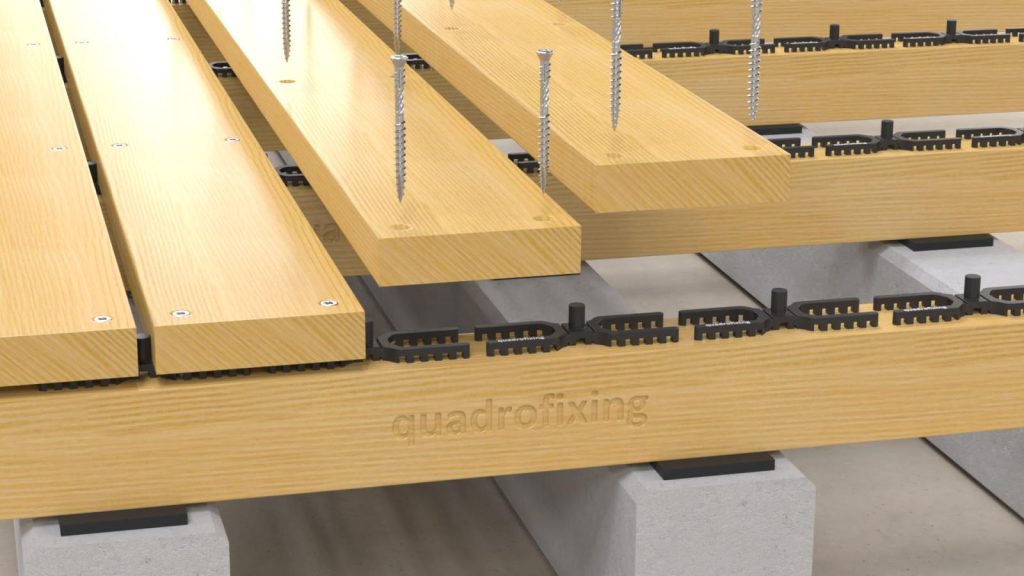
A spacer beneath a decking board leaves an air gap above the joist. Reducing direct timber-to-timber contact helps that joint dry after rain.
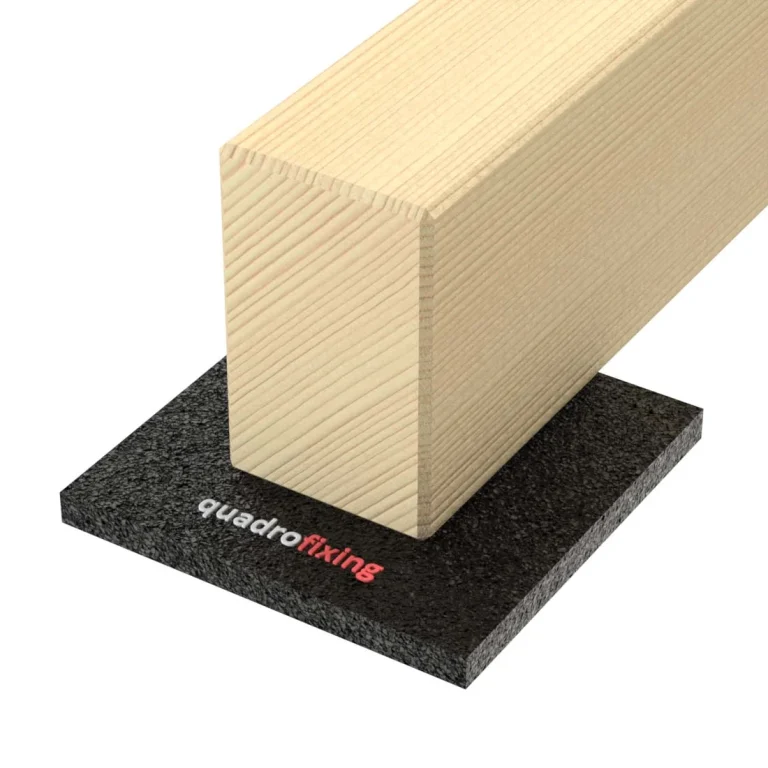
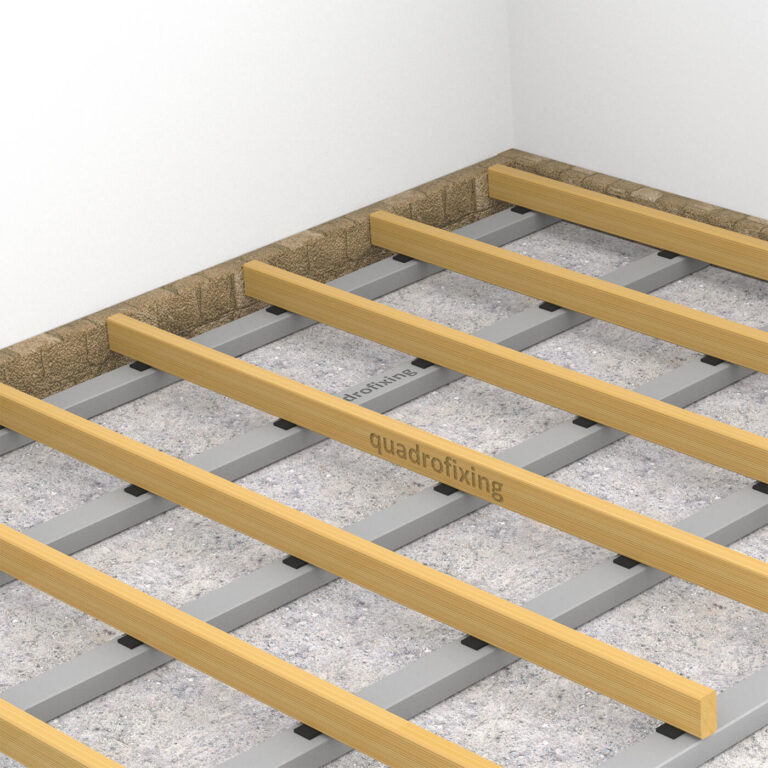
A rubber pad below the frame instead separates the joist from concrete or paving. It helps reduce moisture transfer at the contact point and can limit impact noise.
Indicative estimates are up to 20% less installation time and up to one third longer service life for softwood decking. These are estimates rather than guaranteed outcomes; the frame design, drainage and site conditions remain important.
- Ventilation at the joint: a gap helps moisture escape between board and joist.
- Separation beneath the frame: rubber reduces hard contact with the base.
- Consistent support: purpose-made components provide predictable dimensions.
- Board spacing: only products with a spacing pin or tab set the gap between neighbouring boards.
A spacer does not replace the correct screw or fixing design. With products that only lift the board off the joist, set the board-to-board gap separately.
The main types
Board-to-joist spacers
These sit between the decking board and its supporting joist. Some also include a pin that sets the gap to the next board. Others only create the ventilation space below the board.
Rubber support pads
Recycled rubber or EPDM pads sit below the frame. They provide separation and cushioning, and suitable products can make small height corrections. Self-adhesive versions help keep the pad in position during installation.
Only stack pads where the product allows it. A soft or unstable stack is not a substitute for a proper support.
Adjustable pedestals
Pedestals provide a larger height adjustment beneath a frame or paving. Example height ranges are around 25–270 mm, with other products available for different build-ups.
Self-levelling pedestals
A tilting head compensates for the angle of the base. Depending on the system, examples cover slopes around 5–7%. Height still needs to be set correctly; the moving head only addresses the angle.
Fixed-height supports
Fixed supports are useful where the base is accurately prepared and only a small lift is needed. Example heights include 2, 10, 15, 20 and 30 mm. They are simple and economical, but have less scope for adjustment.
Which component belongs where?
| Component | Main function | Position |
|---|---|---|
| Decking spacer | Creates a ventilation gap | Between board and joist |
| Rubber or EPDM pad | Separates and cushions the frame | Between joist and base |
| Adjustable pedestal | Sets the support height | Beneath a frame or paving |
| Self-levelling pedestal | Compensates for base slope | On a suitably prepared sloping base |
| Fixed support | Provides a small, fixed lift | On an accurately prepared surface |
Dimensions and material examples
QUADRO GF spacers use PA6-GF30 polyamide with 30% glass fibre. The stated dimensions are approximately 84 × 25 × 6 mm and an indicative consumption of 16 pieces/m². Actual quantities depend on board width, joist centres and the fixing layout.
Rubber support pads include sizes such as 80 × 30 mm with thicknesses from 3 to 8 mm. Confirm whether the individual product is recycled rubber or EPDM, and check its bearing properties.
Different support types cover height solutions across 0–270 mm and slope correction across 0–7%. These figures refer to a range of products, not a single support that necessarily covers the entire range.
Spacer costs are typically estimated at around 1–2% of the total deck cost. Their contribution depends on using them in the correct detail rather than simply adding more components.
Examples used in timber decking
QUADRO H

QUADRO H separates the board from the joist and includes spacing options of 4 or 7 mm between adjacent boards. Choose the gap for the board material and installation conditions.
QUADRO GF
This glass-fibre-reinforced spacer provides a rigid separation beneath the board. It is intended to help the joint dry and maintain a consistent support detail.
Watch the QUADRO GF installation video.
Eurotec Dista-Leiste 2.0
This polypropylene spacer strip has ventilation channels and a length of 70 cm, allowing it to be positioned along the joist. The gap between neighbouring boards is set separately.

Star-shaped spacers are another way of providing separation at the board-to-joist connection. Check their dimensions and installation instructions for the proposed decking.
QUADRO PAD
Support pads, including examples measuring 8 × 100 × 100 mm, sit beneath the frame. They cushion the bearing point and help keep timber away from a damp base. Select the material and thickness for the load and surface below.
QUADRO TAPE
The 77 mm wide EPDM tape described in the guide is applied over the top of the joists. It protects the upper contact area from water and complements the ventilation detail. Timber still responds to moisture elsewhere, so tape does not remove the need for drainage and airflow.
Plan the support detail before fitting the boards
Choose spacers, pads and pedestals to suit the board size, frame, exposure and available height. The complete arrangement should remain stable under load and allow water to leave.
For more detail, read our guides to rubber pads beneath the frame and designing a decking subframe.